Showing posts with label performance. Show all posts

Saturday, April 03, 2010

Performance, architecture, construction


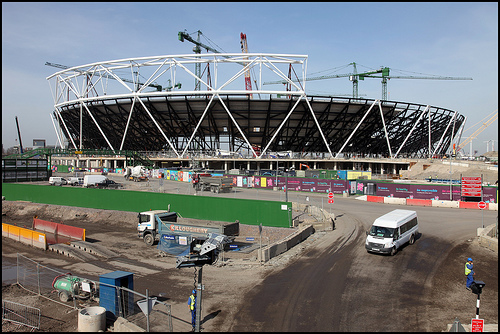
[London Olympic Stadium under construction]


What are the intersections between performance, architecture and construction? Tim Ingold and Elizabeth Hallam provide a useful orientation in the introduction to Creativity and Cultural Improvisation (2007: 3-4). Here they write:
A famous modern architect designs a building, the like of which the world has never seen before. He is celebrated for his creativity. Yet his design will get no further than the drawing board or portfolio until the builders step in to implement it. Building is not straightforward. It takes time, during which the world will not stop still: when the work is complete the building will stand in an environment that could not have been envisioned when it started. It takes materials, which have properties of their own and are not predisposed to fall into the shapes and configurations required of them, let alone stay in them indefinitely. And it takes people, who have to make the most of their own skill and experience in order to cajole the materials into doing what the architect wants. In order to accommodate the inflexible design to the realities of a fickle and inconstant world, builders have to improvise all the way. There is a kink, as Stewart Brand writes, between the world and the architect's idea of it: 'the idea is crystalline, the fact fluid' (Brand 1994: 2). Builders inhabit that kink.
I've often heard it said that the backstage areas of theatres are like building sites, in that the sort of labour that goes on in both involves similar skills and practices, similar working conditions and dangers. Both sites of labour necessitate precise timing and scheduling, the meeting of deadlines and the skillful handling and processing of materials. Would it be productive to think further about the intersections between theatres and building sites or, more specifically, between the act of performance and the act of construction? It strikes me that approaching construction from the perspective of performance might shed light on why construction and building are so little considered or discussed in wider culture. Building sites are often treated as eyesores, simply necessary pains, rather than sites of becoming that are a central means through which we organize, arrange, mark and distribute the world in which we live. Perhaps the 'ontological queasiness' that Jonas Barish has identified as a part of what he dubs the 'anti-theatrical prejudice' might also influence our dominant views of construction and building.

Tuesday, April 21, 2009

Performance Theology

[Salat - Wikipedia]

I've just read an article by Peter Civetta in the Spring 2008 edition of Performance Research entitled 'Body/Space/Worship: Performance Theology and Liturgical Expressions of Belief'. In it Civetta explores the relationship between performance and theology through two case studies: the first being the practice of Jum'ah Prayer in the Al-Nur Mosque in New York and the second looking at the impact of spatial layout on liturgical experience at Grace Episcopal Church in Chicago.

Discussing the first, Civetta observes that the possible meanings of the physical actions in salat (prayers) are rarely (if ever) speculated upon by Muslim believers; the actions are simply learnt and then reproduced. Civetta suggests that a result of this is that Muslims remain open to the experience of the actions: "Without recourse to definitive judgements as [to] what the movements represent, they must sit and experience them for what they are." (9) Reflecting further on this Civetta explains,
From this experience, I gain increased recognition of belief as not wholly thought, not a solely conscious and intellectualized process of discernment and acceptance (or rejection). Performance theology lives as a bodily function; how these people choose to live their lives is in part dictated by what they learn from their bodies (not their minds) in the act of prayer [...] Belief not only gets expressed by the body - an aftereffect of previously determined ideas - but comes from the body as well. (10-11)
With the example of Grace Episcopal Church Civetta comments on the restrictive nature of the building's spatial layout. Built in an English Gothic Revival style between 1898 and 1905 the church is a large and imposing structure that attempts in some way to reproduce the grandeur of European cathedrals. According to Civetta, the physical dimensions of the church - the sheer distances between floor and ceiling and from end to end - suggest "an epic God and a distant God", circumscribing the notion of God as Abba (Daddy). After discussing the positions and features of the high altar, pulpit and baptismal font Civetta turns to briefly discuss the lived experience of the space, commenting that in the weekly life of the congregation the space itself mitigates against intimacy and communality and instead "puts the emphasis for worship on individuality and visuality." (16) He summarises:
In this way, spatiality at Grace Church possesses its own performance theology, and that performance theology has determined to a large extent the possible performance theology of the worshiping congregation. (17)
It's an interesting article and does outline approaches for other performance scholars to take when exploring religious experience; the suggestion to avoid simply theatricalizing liturgy but to take into account its status as worship is a helpful one. At the same time I'm also uncomfortable with the way Civetta uses the term 'determined' in the sentence I've quoted above; can spatiality or architecture actually determine anything? In his analysis he places a great deal of importance on spatiality without, perhaps, taking into account wider sociocultural, historical and theological contexts that might also reinforce the influence of space on the lived experience of the congregation.

Finally, reading this article through my own particular 'binocular' view - as a Christian and a performance scholar - I also take it as a challenge to re-examine my own 'performance theology', considering how what I do necessarily impacts upon what I believe and how, in the knowledge of this, I might instead seek to enact a more 'faithful' performance.